
Packaging is everywhere. There is almost nothing you buy that hasn’t passed through a filling machine at some point, and this is far from a recent development. Filling liquids into containers is a technology with centuries of history: long before automation, wine, milk and syrups were already being measured and packaged for sale.
What has changed is not the need to fill a container accurately, it’s how much is riding on getting it right in a modern, high-speed plant. This guide focuses specifically on volumetric and mass liquid filling machines, the technology family used across most home care, personal care and health care liquid production, and on what actually determines whether a filler holds its accuracy once it leaves the FAT and enters a real, “living” production line.
The bigger picture: more than one way to fill a bottle
Before going further, it’s worth being upfront about scope. Filling technology is a broad field, and no single machine builder (including us) works across all of it. Liquid filling systems are generally grouped into four families:
- Volumetric systems. Dose by measured volume: piston, rotary pump (gear or lobe), flowmeter-controlled, timed flow, auger/screw, progressive cavity pump, and peristaltic.
- Ponderal (weight-based) systems. Dose by gross or net weight, using load cells.
- Level-based systems. Dose by overflow or by electronic level detection.
Each family exists because it solves a specific combination of product, container and speed constraints, there is no universally “best” system. If you’d like the full historical picture of how these technologies developed, we’ve covered that in more depth in The Origins of Filling Technology Part I and Part II.
This article stays inside one family, volumetric, because it’s the one we build, test and refine every day: flow-controlled dosing (Mass Flow & Mag Flow) and positive-displacement piston dosing. What follows is what we’ve learned about making that specific technology hold its accuracy under real plant conditions.
More than fluid transfer: the filler’s role as the heart of your plant
In a demanding manufacturing environment, a volumetric filling machine is not just a fluid transfer device; it is the heart of the packaging line and a main driver of the plant’s Overall Equipment Effectiveness (OEE).
Beyond its basic definition, the role of an industrial filler is to isolate the packaging process from plant design inefficiencies. An advanced machine takes responsibility for three critical pillars that must not fail: accuracy, stability, and long-term repeatability.
This equipment is vital because any failure or lack of consistency has a direct and highly expensive impact: unplanned downtime, product giveaway, aesthetic rejections due to nozzle dripping, and an excessive dependency on manual adjustments by operators.
Real-time filling: why traditional feedback models fail in modern plants
To understand the difference between a standard machine and a high-performance system, we must look at how they react to error.
Historically, standard systems (whether net weight fillers or basic flowmeters) operate on a delayed feedback model. This process is reactive: the machine measures the error in the bottle it just filled and applies a correction to the next one.
The problem: in a real-world plant, conditions change every millisecond. If pipe pressure drops exactly when a bottle is under the nozzle, correcting the next bottle does nothing to save the current one. The result is a constant cycle of overcompensation, product giveaway, and inconsistent fill levels.
In modern volumetric filling, the focus shifts to real-time monitoring. Instead of waiting until the end of the cycle, advanced systems analyze external variables (flow, density, pressure) and recalculate the valve’s closing point up to 100 times per second.
In this context, “accuracy” is not measured under ideal laboratory conditions. True industrial accuracy (σ < 0.15%) is maintained under real production conditions, actively compensating for instability coming through the pipes.
The 4 “Hidden Enemies” of Volumetric Filling Efficiency
It’s a story that repeats often: a manufacturer buys a machine that fills with mathematical precision during the FAT, only to see its performance degrade within a week of installation.
Why does this happen? Because most filling challenges do not originate in the machine, they are born in the environment surrounding it. For volumetric filling equipment to be truly efficient, it must act as a “shield” against four major instabilities:
- Supply instability: In a “living” plant, other machines start and stop, causing sudden pressure drops or thermal variations. A passive filler is easily confused by these changes; a high-level system is designed to compensate for them without stopping production.
- Product variability: Between different batches, viscosity or density can fluctuate. Modern technology must offer immediate technical flexibility, letting the system adapt to the product’s behavior rather than forcing the product to fit a rigid machine setting.
- The chaos of flow (foam and turbulence): Filling at high speeds naturally creates turbulence. The traditional “patch” has been to use internal meshes or filters to break the flow, but these are notorious hygiene risks. The modern answer lies in Computational Fluid Dynamics (CFD), designing nozzles that ensure laminar flow from the start, without the need for extra internal components.
- The OEE Killer: cleaning cycles (CIP). Time spent not producing is money lost. While market standards often require manual disassembly and up to 100 minutes of downtime, advanced sanitary designs (such as 360º Closed Loop systems) can reduce “CIP-to-Production” time to just 15 minutes.
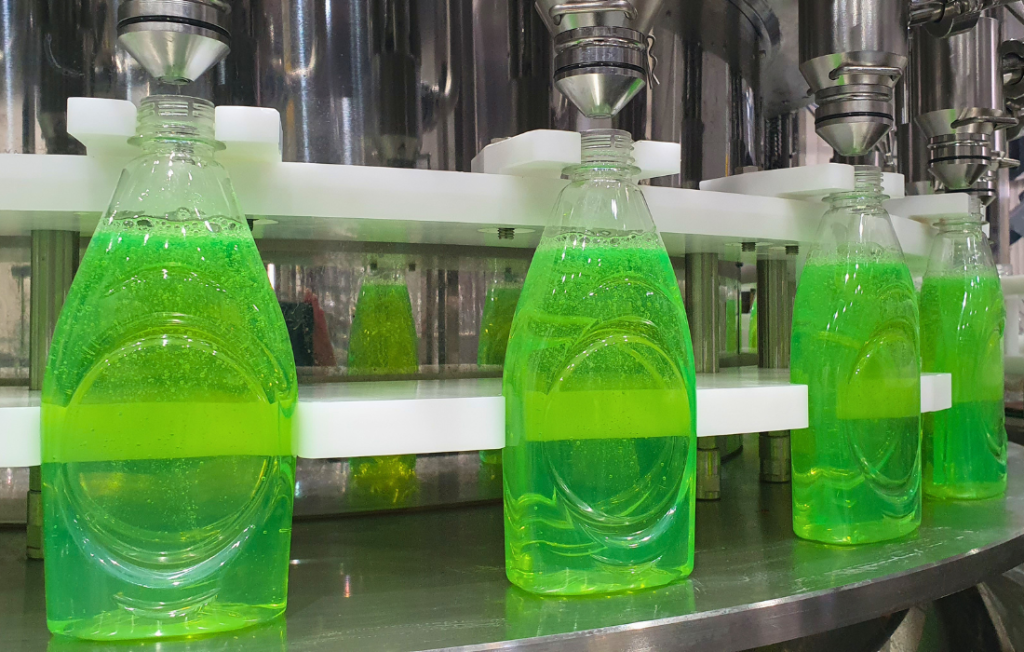
Understanding these variables is what separates a simple machinery purchase from a strategic long-term investment. And even within volumetric filling, choosing a dosing platform is never one-size-fits-all, it must be a direct response to the specific nature of your product and process.
Choosing between volumetric platforms: Flow-Controlled vs. Piston
Within the volumetric family, we work with two core platforms. Which one fits depends entirely on the product:
Mass Flow & Mag Flow Technologies
The most versatile and innovative solution for liquids ranging from thin and foaming to highly viscous. They isolate the machine from plant inefficiencies, guaranteeing exact doses from the very first bottle using SmartFlow® and Enhanced Accuracy®.
Piston Pump Technology
Ideal for high-accuracy microdosing or when strict product flow control is required. It utilizes Ceramic Piston Technology (no wear-and-tear gaskets) and a closed-loop continuous recirculation system that keeps the product moving, avoiding the sedimentation of solid particles.
Piston Pump and Hot Filling Technology
Designed for formulations that are solid at room temperature (like candles or stick deodorants). It uses a double-jacketed product path with continuous recirculation of thermic fluid to ensure a constant and homogeneous temperature without thermal drops.
Piston Pump and Multi-Stream Technology (Swirl Filling)
Capable of controlling multiple simultaneous product streams with extreme precision to create unique visual patterns and swirls directly inside the container.
Strategic integration: Reducing line complexity with monoblocks
A common mistake is analyzing the filler as an isolated island. For a plant manager, the most significant risks (spills, contamination, or speed loss) often lurk in the “limbo” that exists between the filler discharge and the capper infeed.
Transitioning to Monoblock systems is not merely about saving space, though the reduction in floor footprint is drastic. It is a risk-mitigation strategy. By mechanically synchronizing filling and capping, you eliminate the instability of transporting open containers on conveyor belts.
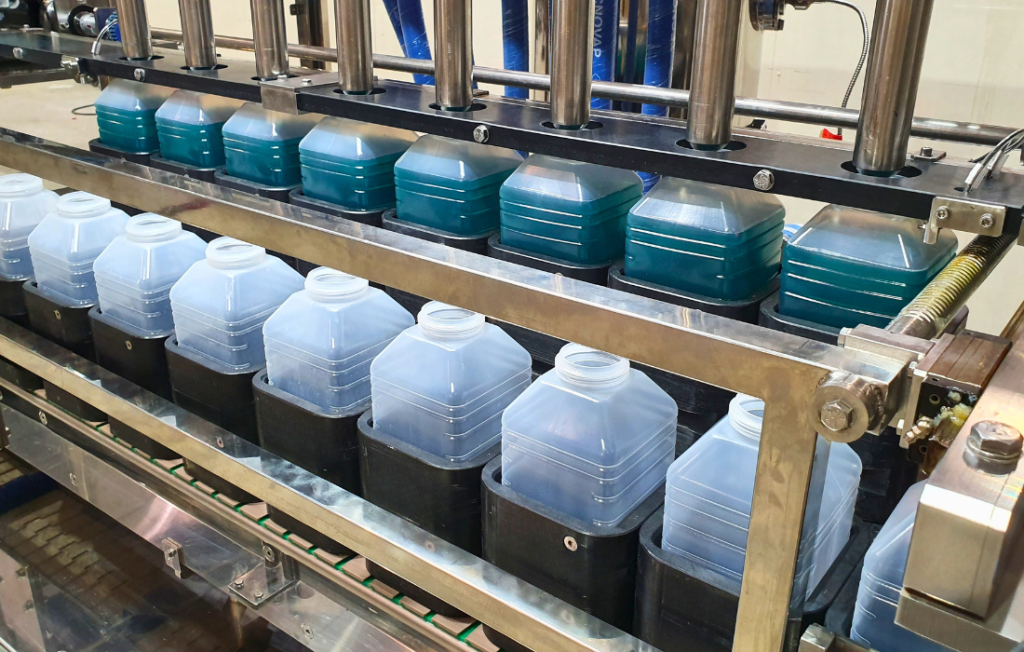
This immediate closure is vital for volatile products or large-format containers (such as 15-liter jugs), ensuring that the precision achieved during filling isn’t lost during transit. Furthermore, integration unifies the line control into a single interface (HMI), reducing operator error and streamlining data collection.
Shielding the asset: Engineering for extreme and corrosive environments
When processing aggressive or flammable fluids, filling technology must be as resilient as it is precise. In these scenarios, the equipment should be viewed as a fortress designed to protect both the product and the investment.
The Battle Against Corrosion
Filling strong acids or aggressive chemicals can degrade standard metals in months, tanking your OEE. The technical response goes beyond just using stainless steel; it requires integrating noble materials like Titanium or Hastelloy and technical coatings such as Halar. The goal is for the machine to retain its value and accuracy after decades of chemical exposure.
Safety in Flammable Environments
When handling solvents or alcohols, safety is the foundation of the design, not an add-on. Compliance with global directives (ATEX, NEC, CEC) is more than a legal formality, it is about ensuring business continuity and operator safety through active defense systems and overpressurized base frames.
What to consider when evaluating a volumetric liquid filling machine?
A liquid filling line is a 20-to-30-year investment. Therefore, selection criteria should never be based on the theoretical speed listed in a catalog, but rather on real-world process stability.
Before choosing a partner, perform a rigorous technical diagnosis of your needs:
- Reaction capacity: How does the machine react to a sudden pressure drop in the plant?
- True downtime: How much time is actually lost during a cleaning cycle or a format change?
- The engineering partner: Is the supplier simply a “box mover,” or an engineering-driven partner capable of adapting the machine to your specific plant constraints?
The true value of a filling machine is not measured on the day of installation. It is measured years later, when it continues to deliver the same repeatability as day one, shielding your production from the inevitable turbulence of the industrial environment.
Let’s talk about your process
Most packaging problems do not start in the machine, they start in the variability of the process itself. Evaluating a filler based solely on theoretical speed is a recipe for operational failure.
Leading high-performance industries know that an efficient machine is one that offers stability against a fluctuating environment, guarantees repeatability over the years, and maximizes OEE.
At Mengibar, every engineering decision starts with the analysis of your process constraints. A filling line is a decades-long investment; our value starts when we analyze those challenges together.