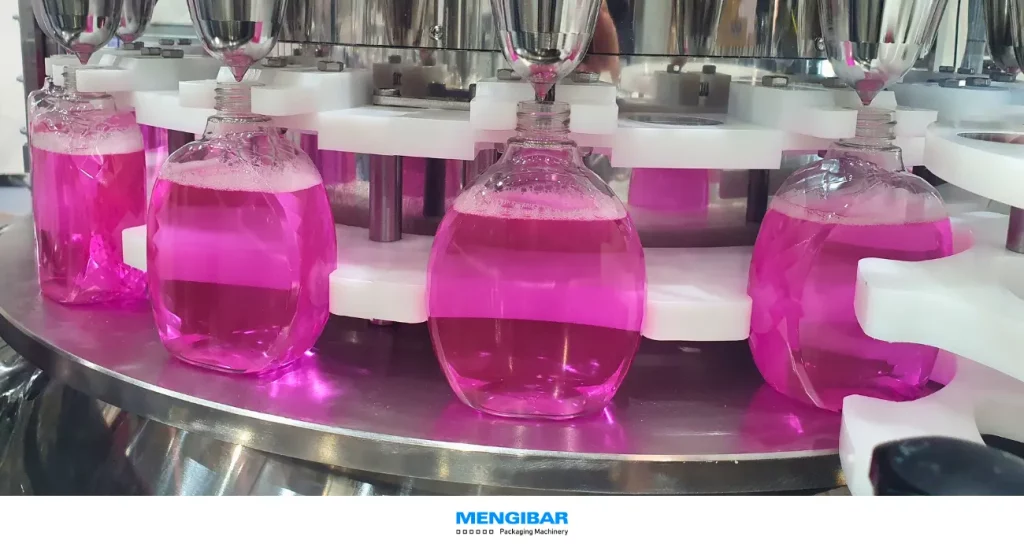
In liquid filling operations, accuracy is often treated as a simple metric: delivering the exact target dose into each container. However, in real production environments, filling accuracy goes far beyond hitting a nominal value.
It directly impacts product loss, line efficiency, regulatory compliance and overall operational stability. For manufacturers working with high volumes or high-value products, even small deviations can translate into significant costs over time.
Understanding what filling accuracy really means (and how to improve it) requires looking at the process as a whole, not just the machine.
What does “filling accuracy” really mean in production?
In laboratory conditions, filling accuracy is typically defined as how close each dose is to a target value under stable, controlled parameters. In production, this definition is incomplete.
Real accuracy is not only about hitting the target once, but about maintaining consistent dosing over time despite continuous variations in the process. This is usually measured through statistical indicators such as standard deviation and process capability, rather than isolated measurements.
In this context, a filling system can appear accurate in controlled tests but still generate variability on the line if it cannot adapt to real operating conditions.
Why filling accuracy directly impacts costs and performance
One of the most direct consequences of poor filling accuracy is giveaway, the systematic overfilling of containers to avoid underfill risks. While this may ensure compliance, it comes at a cost. Over time, even small overfills accumulate into significant product losses, especially in high-speed lines.
At the same time, underfilling introduces regulatory and quality risks, potentially affecting brand reputation and compliance with labeling requirements.
Beyond product loss, inconsistent filling also impacts line efficiency. Variability can lead to rejects, rework, and unstable downstream processes, reducing overall equipment effectiveness (OEE).
In many cases, the biggest hidden cost is not visible in the machine specification, but in the long-term operational inefficiencies.
Main factors that affect filling accuracy
Filling accuracy is highly sensitive to process variability. Some of the most common factors include:
- Product variability: changes in viscosity, density or temperature directly affect how the liquid behaves during dosing
- Air content: entrained air or cavitation can alter volume measurement and lead to inconsistent fills
- Unstable product supply: fluctuations in pressure or flow disrupt dosing consistency
- Foaming and turbulence: especially in home and personal care products, foam can distort measurements and slow down the process
- Filling system design: nozzle type, flow control and dosing method all influence stability
- Upstream interaction: tanks, pumps and piping conditions can introduce variability before the product even reaches the filler
In practice, many filling issues do not originate in the machine itself, but in how it interacts with the overall process.
Why traditional filling technologies struggle with variability
Many conventional filling systems are based on control strategies that react to previous cycles. In simple terms, the system measures a deviation and corrects it in the next fill. This approach works under stable conditions, but becomes problematic when the process is continuously changing.
Because the correction is delayed, the system tends to overcompensate, which often leads to increased giveaway. When combined with unstable product behavior or supply fluctuations, this can result in a cycle of constant adjustment without true stabilization.
This is particularly critical in high-speed applications, where even small deviations are amplified across thousands of units per hour.
Rotary systems, widely used for their output capacity, can also face limitations if they are not designed to actively manage process variability. You can explore this in more detail in our article on what rotary fillers should really do.
How to improve filling accuracy in real production environments
Improving filling accuracy requires shifting the focus from isolated precision to process stability and control.
Rather than reacting to deviations after they occur, advanced filling systems are designed to monitor and adjust the process in real time. This allows the machine to continuously adapt to changes in product behavior, supply conditions or environmental factors.
This approach reduces dependency on operator intervention and prevents variability from accumulating across cycles.
In this context, filling technology must actively compensate for process instability, not just measure it.
In Mengibar fillers, this is addressed through systems designed to operate under real production constraints. For example, enhanced control strategies can monitor and adjust the dosing process continuously, preventing deviations before they become cumulative errors.
In practical terms, this enables dosing deviations in the range of ±0.1% under production conditions, while maintaining stability even with variable products.
This becomes especially important in applications where product value is high, formats are multiple, or tolerances are tight.
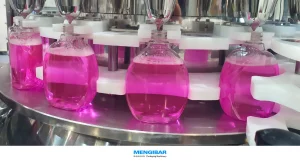
A clear example can be seen in this cosmetic application, where the challenges included achieving accurate and consistent filling of highly viscous products, ensuring fast and efficient cleaning cycles, and handling multiple formats within a compact footprint.
The role of technology in reducing giveaway and variability
Advances in filling technology have not focused on eliminating variability, but on managing it. In real production environments, conditions are rarely stable. The ability to detect and compensate for changes as they happen is what defines performance.
Technologies based on continuous monitoring and fast-response control systems allow dynamic adjustment of dosing parameters, reducing both overfill and variability.
This contrasts with traditional systems that rely on delayed feedback and fixed control logic.
It is also important to understand that filling performance depends on the entire process. Upstream or downstream operations, such as cooling, can directly affect product behavior and filling stability.
At high speeds, the impact of variability becomes even more critical. Small deviations can quickly scale into significant product losses if not properly managed.
What to consider when evaluating filling accuracy
When assessing filling performance, focusing only on nominal accuracy values can be misleading.
A more reliable evaluation should consider:
- performance under real production conditions, not only laboratory tests
- the system’s ability to handle process variability
- consistency over time, not just individual measurements
- impact on giveaway and product loss
- integration with the rest of the production line
Improving filling accuracy is not only about selecting a machine capable of delivering precise doses, but about understanding how variability is managed across the entire process.
In real production environments, stability, control and repeatability are often more relevant than theoretical precision. Each product behaves differently. Each factory has its own constraints. Each line presents its own challenges. For this reason, filling solutions cannot be standardized.
At Mengibar, each rotary filler is designed based on the specific characteristics of the product, the production environment and the operational goals. From handling highly viscous formulations to managing multiple formats within limited space, the solution is always adapted to real conditions. Because in liquid filling, one size does not fit all.
If you are currently evaluating how to improve filling accuracy, reduce giveaway or optimize the stability of your process, we would be glad to review your case with you. You can request a personalized consultation or explore how our solutions can be adapted to your specific needs and product goals.