In hot filling lines for products such as stick deodorants, balms, waxes, solid air fresheners or semi-solid formulations, post-filling thermal behavior is a decisive factor. Accurate dosing alone is not enough: final texture, dimensional stability, the absence of cavities or cracks, and resistance during transport all depend on controlled and repeatable cooling.
In this context, cooling tunnels stop being auxiliary equipment and become a critical element within the production line.
Most solutions available on the market are based on water cooling tunnels, using showers, cascades or spray systems. These systems accelerate heat transfer but also introduce a number of well-known drawbacks in demanding industrial environments: wet packaging, increased microbiological risk, the need for downstream drying, the creation of humid areas in the plant, and high energy consumption associated with water treatment and refrigeration.
Mengibar cooling tunnels: a hygienic and controlled approach
Mengibar cooling tunnels have been specifically developed to eliminate these compromises. This enables hygienic and controlled cooling in hot filling lines without introducing moisture into the process.
Key characteristics of Mengibar air cooling tunnels
In practice, this means that:
- No water or mist is used.
- Neither the container nor the product gets wet at any stage.
- The process operates with dry, filtered and recirculated air.
- The environment remains completely dry, compatible with demanding sectors such as cosmetics, pharmaceuticals, and installations with ATEX or GMP requirements.
Water cooling tunnels vs. Mengibar cooling tunnels
Water-based cooling tunnels have historically been the standard in many hot filling lines. However, their operating principle introduces a series of side effects that directly impact the process, the plant environment and overall operational efficiency.
Parameter
Conventional water cooling tunnel
Mengibar air cooling tunnel
Heat exchange medium
Cold water (showers, cascades, spray)
Dry, recirculated and filtered air
Container condition at tunnel exit
Wet, requires downstream drying
Dry, ready for subsequent processes
Microbiological risk
Micro-biological risk
High: biofilm formation, legionella, biocide control
Very low: no water, air filtration
Impact on the product
Possible thermal shock and internal stresses
Progressive and controlled cooling
Maintenance
Circuit cleaning, disinfection and descaling
Standard mechanical maintenance, no water treatment
Energy consumption
Pumps, water chillers, ventilation
High-efficiency fans, lower thermal demand
Environmental conditions
Humid area, condensation, corrosion risk
Dry area, improved equipment durability
Downstream drying
Required (air blowers / air tunnel)
Not required
In conventional water cooling tunnels, heat exchange is achieved using cold water through showers, cascades or spray systems. As a direct consequence, containers exit the tunnel wet and require a subsequent drying stage before proceeding to processes such as labeling or printing. In addition, the constant presence of water increases microbiological risk, including biofilm formation and the need to control legionella through biocides and regular cleaning.
From a product perspective, these systems can generate thermal shock and internal stresses if cooling is not managed progressively. Operationally, they involve demanding maintenance tasks—such as circuit cleaning, disinfection and descaling—and high energy consumption associated with pumps, water chillers and auxiliary ventilation systems. The result is often a humid plant environment, with condensation and corrosion risks, and increased complexity in day-to-day line management.
By contrast, Mengibar cooling tunnels use dry, filtered and recirculated air as the heat exchange medium. Containers exit the tunnel completely dry, ready for subsequent processing stages, without the need for additional drying. By eliminating the use of water, microbiological risk is drastically reduced, and maintenance is limited to standard mechanical operations, without chemical treatments or wet circuits.
Cooling is carried out in a progressive and controlled manner, preventing internal stresses in the product. From an energy standpoint, the system relies on high-efficiency fans, with lower thermal demand and a dry working environment that improves both equipment durability and overall plant conditions.
Cooling tunnel architecture and cooling concept
The design of Mengibar cooling tunnels always starts from the specific thermal profile of the product and the real requirements of the production line. There is no single standard solution suitable for all formulations.
Key parameters are analyzed, including:
- Filling temperature and target temperature at tunnel exit.
- Required residence time depending on the formulation (melting point, wax and oil content, etc.).
- Cooling curve definition to avoid excessive gradients and defects such as collapse, cracking or shrinkage.
From an engineering standpoint, this approach translates into:
- Independent cooling zones with precise control of air temperature and flow rate.
- Homogeneous air distribution through plenums and nozzles, avoiding cold spots and dead zones.
- Air recirculation with filtration systems, optionally up to HEPA levels depending on the application.
- The possibility of combining cooling with humidity control to prevent condensation in lines with significant thermal fluctuations.
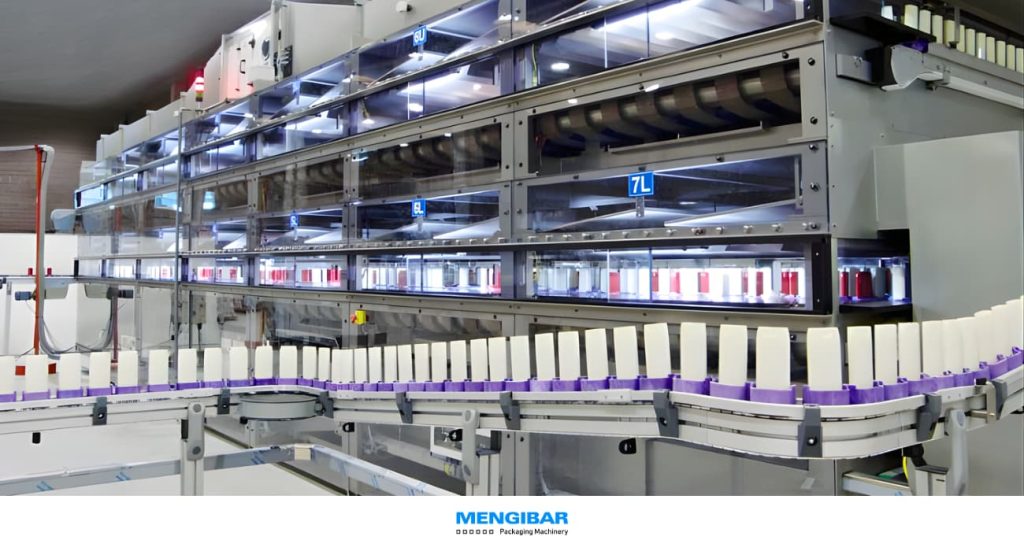
Two design concepts in cooling tunnels: serpentine and longitudinal belt
To adapt to different plant layouts, residence times and flexibility requirements, Mengibar manufactures cooling tunnels in two main configurations.
1. Serpentine-type cooling tunnels
Designed for installations with space constraints or long cooling times.
- The product travels through the tunnel on multiple belts or levels, following a serpentine path.
- Residence time is maximized per square meter of occupied floor space.
- Integration is facilitated in existing facilities where available footprint is limited but height can be used.
This design is particularly suitable for:
- Formulations with a high wax or fat content.
- Large-volume products requiring deep core cooling.
- Lines with medium-to-high production requirements and very limited space.
2. Single longitudinal belt cooling tunnels
Designed for continuous flow lines and high production speeds.
- The product is conveyed on a single longitudinal belt at constant speed.
- Process control is simplified, as residence time is determined by tunnel length and belt speed.
- Changes in direction and container handling are reduced. This allows for, lower risk of tipping, reduced vibration and micro-damage and improved stability for tall products or containers with a high center of gravity.
This concept is especially suitable for:
- High-speed production lines.
- Integration into linear production flows (filling → cooling → labeling or cartoning).
- Delicate or premium formats that must not suffer marks or abrasion.
Both designs can be configured with different belt widths, usable heights, protections and filtration levels, and can be combined with accumulation or bypass systems depending on line logic.
Integration of cooling tunnels into the production line
Mengibar cooling tunnels are designed so they do not become a bottleneck. Their nominal capacity is higher than that of the filler, which is considered the critical machine in the line.
This makes it possible to:
- Absorb product during downstream micro-stoppages (labeling or cartoning).
- Avoid unnecessary filler stoppages due to insufficient cooling capacity.
- Operate according to the V-curve philosophy, with the cooling tunnel supporting line capacity without limiting it and the filler remaining the performance reference.
In addition, the dry environment simplifies both the downstream installation of vision systems, lasers, cameras or dynamic checkweighers, and compliance with requirements in sectors such as cosmetics, pharmaceuticals or ATEX environments, in combination with other Mengibar equipment.
Applications and reference cases of cooling tunnels
Mengibar cooling tunnels are in operation in production lines for:
- Stick deodorants and antiperspirants, including ATEX environments.
- Solid air fresheners and hot-poured fragranced products.
- Balms, waxes and other semi-solid products.
In these applications, where hot filling requires precise and repeatable thermal control, the cooling tunnel ceases to be auxiliary equipment and becomes a key element in process stability and overall line efficiency.
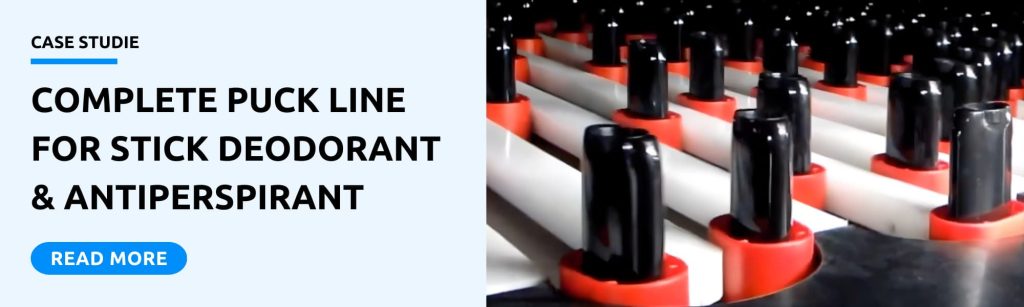
A representative example is the puck line with a hot filling tunnel, where the cooling tunnel is fully integrated into the production logic to ensure proper product solidification, packaging integrity and process continuity, even in demanding industrial environments.