

As production volumes grow, manufacturers eventually reach a point where a conventional packaging line is no longer enough. The question is no longer whether filling and capping should be integrated, but when that transition makes sense.
In most cases, moving to a monoblock filling machine is not driven by the type of product being filled or by cost. It is driven by production speed. Once rotary technology becomes necessary, integrating filling and capping into a single machine often becomes the most efficient solution.
This article explains when that transition makes sense, the advantages of a monoblock filling machine, and the key factors to consider before investing in an integrated system.
What is a monoblock filling machine?
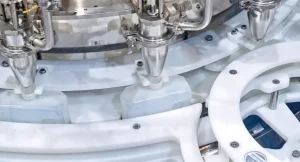
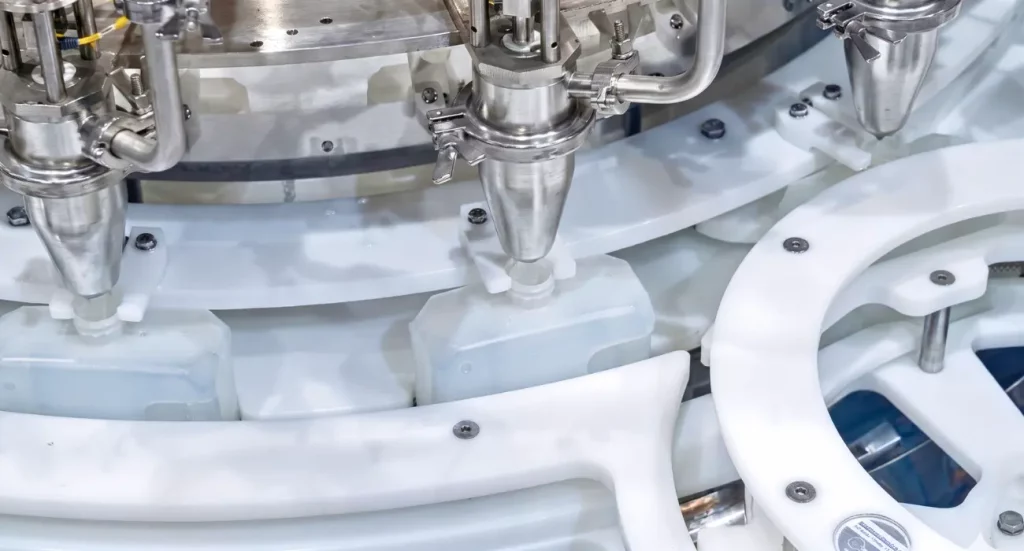
A monoblock filling machine is an integrated packaging solution that combines filling and capping into a single rotary system. Instead of moving bottles between stand alone machines, containers move directly from the filling station to the capping station in one continuous, synchronized process.
This configuration minimizes bottle handling, eliminates intermediate transfer points and improves the overall stability of the packaging process. By keeping both operations within the same machine, manufacturers can achieve higher productivity while maintaining filling accuracy and consistent capping quality.
Unlike linear packaging systems, where filling and capping are performed on stand alone equipment, a monoblock is specifically designed for high-speed production environments, offering a compact footprint and simplified line operation.
Why choose a monoblock filling machine?
Manufacturers rarely choose a monoblock simply because it combines two operations in one machine. The real reason is that, as production increases, rotary filling and rotary capping become the preferred technologies.
Once both operations require rotary equipment, integrating them into a single monoblock simplifies the packaging line while improving overall performance. The main advantages include:
Higher production efficiency
Because filling and capping are fully synchronized, bottles move continuously through the machine without accumulating between separate pieces of equipment. This creates a smoother production flow, reduces interruptions and maximizes line efficiency.
Improved product integrity
Minimizing the distance between filling and capping reduces the time containers remain open. This helps preserve product quality and lowers the risk of contamination, particularly for sensitive formulations.
Better use of factory space
Replacing two independent rotary machines with a single integrated system significantly reduces the installation footprint, making monoblocks an excellent solution where production space is limited.
Simplified operation
Operators manage one centralized control system instead of coordinating two independent machines. This simplifies setup, production monitoring and format changes.
Greater process consistency
Keeping bottle handling, filling and capping within the same synchronized system improves repeatability throughout long production runs, helping maintain consistent filling accuracy and capping quality.
When does it make sense to move to a monoblock filling machine?
There is no universal production threshold, but in many packaging applications the transition to rotary technology begins at around 80 bottles per minute.
At these production speeds, rotary capping is generally required to maintain consistent performance. Since filling also benefits from rotary technology, integrating both operations into a monoblock becomes the most efficient solution.
Instead of installing two stand alone rotary machines, manufacturers can simplify the packaging line with a single synchronized system that occupies less space, reduces bottle transfers and is generally more cost-effective than purchasing two independent rotary machines.
However, production speed is only part of the decision. As packaging lines become faster, manufacturers also need greater flexibility to process different bottle formats and closure types without sacrificing productivity.
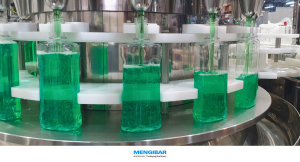
One example is Mengibar’s Multi-Closure High-Flexibility Rotary Monoblock, developed for cleaners and hand soaps. Designed to process multiple closure types on the same machine, it demonstrates how an integrated rotary system can combine high-speed production with exceptional manufacturing flexibility.
Which applications benefit most from monoblock technology?
One of the most common misconceptions is that the choice of a monoblock depends primarily on the product being filled.
In reality, product type is rarely the deciding factor. Monoblock technology can be designed for virtually any liquid formulation. The decision is usually based on production speed, packaging format, closure type and required output rather than on the product itself.
Although suitable for many industries, monoblocks are particularly valuable where precision, cleanliness and productivity are essential.
Cosmetics and personal care
Cosmetic manufacturers often combine multiple bottle formats, viscous formulations and premium packaging within the same production line. A rotary monoblock keeps filling and capping perfectly synchronized while maintaining the speed and accuracy required for high-volume production.
A good example is Mengibar’s project for a manufacturer requiring a single monoblock capable of handling 18 different cosmetic presentations, combining high productivity with exceptional flexibility.
Pharmaceutical and OTC products
Pharmaceutical and OTC applications demand repeatable filling accuracy together with secure closure control.
Mengibar has also developed a monoblock solution for foamy mouthwash, integrating filling, capping and overcapping in a single machine while overcoming the challenges associated with highly foaming products.
Household chemicals
Cleaning products, detergents, disinfectants and other household chemicals benefit from integrated systems capable of maintaining high production speeds across a wide range of liquid formulations.
Applications involving corrosive products can also be engineered with materials and machine configurations specifically adapted to these demanding environments.
Monoblock vs. stand alone filling and capping machines
| Stand Alone Machines | Monoblock Filling Machine |
|---|---|
| Filling and capping performed independently | Filling and capping fully synchronized |
| Bottle transfer between machines | Continuous bottle handling |
| Larger installation footprint | Compact integrated design |
| More operator adjustments | Centralized operation |
| Suitable for moderate production | Ideal for high-speed rotary production |
This is not a comparison between a “good” and a “bad” solution. stand alone filling and capping machines remain the right choice for many production environments.
However, once rotary technology becomes necessary, integrating both operations into a single monoblock usually provides a simpler, more efficient and more compact packaging solution.
How to choose the right monoblock filling machine
Every production process has its own requirements. Selecting the right machine starts with understanding the characteristics of the products and packaging that will run on the line.
Before choosing a monoblock filling machine, manufacturers should define:
- Bottle formats and dimensions
- Product characteristics and viscosity
- Closure types
- Required production speed
- Future production growth
These factors determine the most appropriate machine configuration and ensure the equipment can support both current production needs and future expansion.
Because every application is different, monoblock filling machines are typically engineered around each customer’s production requirements rather than following a standard configuration.
A monoblock filling machine is much more than a machine that combines filling and capping. It is the natural evolution of a packaging line once production reaches the point where rotary technology delivers greater efficiency than stand alone machines.
The right solution depends on factors such as production speed, bottle formats, closure types and future production requirements. Evaluating these elements from the beginning helps ensure that the selected equipment delivers the flexibility, reliability and performance required over the long term.
If your production is approaching the point where rotary technology becomes necessary, explore Mengibar’s Monoblock Filling & Capping Machines to discover solutions engineered for demanding cosmetic, pharmaceutical, OTC and household product applications.
If you’re evaluating your next filling line, explore our Monoblock Filling & Capping Machines to discover configurations designed for high-performance production.